
Posture and Health
Posture and physical health are closely linked. Our inner state is reflected in how we carry ourselves, and maintaining good posture can, in turn, influence our mental well-being. True well-being is possible only when both the mind and body remain relaxed and open.
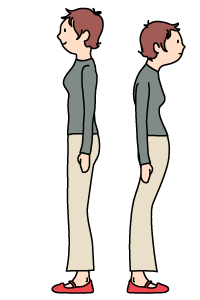
There are many ideas about what “good posture” means. In the Mitzvah Technique, good posture does not mean a straight back or a muscular body.
Rather, it refers to how gravity and the support of the ground reaction force work together to keep us balanced,
and how this balance expresses itself in our everyday movements.
Imagine a small child—flexible, free, and playful, with no stiffness or rigidity and able to fall into deep, restful sleep when tired.

Slouching
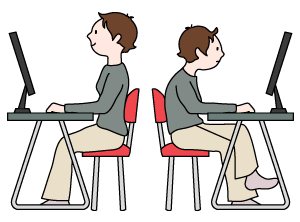
Long hours spent in the same position and a predominantly sedentary lifestyle can lead to slouching.
When you slouch, the muscles in the neck and shoulders tighten, the nervous system becomes stressed,
blood vessels such as the carotid artery are compressed, the lungs lose their full capacity, and the internal organs are pushed downward.
In short, habitual poor posture creates unnecessary muscle tension that gradually distorts the body’s skeletal structure.
Bring awareness to the unnecessary physical and mental tension you may be holding without realizing it.
Effects
The Mitzvah Technique is gentle and its benefits are both immediate and cumulative.
It is appropriate for anyone who wants to improve their body awareness and ease of movement:
 those whose work requires stressful postures or lifting heavy weights,
office workers who sit for long hours in front of a desk,
senior citizens,
people recovering from injuries,
people with spinal difficulties.
Because of its special emphasis on total body functioning the Mitzvah Technique is also valuable for dancers, musicians and actors who want to enrich their performance.